






Automatic Wandering Hour Watch ·
Time Cipher
CIGA design’s first creation of 2026 reimagines time as a cipher in
motion rather than through conventional hands, pairing a wandering
hour display powered by the self-developed CD-08 caliber with a
Super Black dial and a newly sculpted, slim round case with layered
finishes—minimalist in spirit and experiential in wear.


Automatic Wandering Hour
Watch · Time Cipher
CIGA design’s first creation of 2026
reimagines time as a cipher in motion rather
than through conventional hands, pairing
a wandering hour display powered by the
self-developed CD-08 caliber with a Super
Black dial and a newly sculpted, slim round
case with layered finishes—minimalist in
spirit and experiential in wear.

Some taught us to read time in straight lines—hours fixed, minutes obedient.
But time was never meant to be read so plainly. It wanders, overlaps, and reveals itself slowly.
Time Cipher is born from this belief: that time is not announced, but deciphered—
through motion, alignment, and attention.
Against a dial that absorbs almost all light, motion becomes the only clue.
A single, purpose-built form wanders through the darkness, tracing minutes in quiet orbit,
while the rotating hour reveals itself in sequence. Polished indices catch light like signs at the edge of
perception, suspended within a newly sculpted case—minimal, slim, and composed.
On the wrist, Time Cipher feels poised and restrained: a watch defined not by what it shows at once,
but by what it reveals to those who linger.


Some taught us to read time in
straight lines—hours fixed, minutes
obedient. But time was never meant
to be read so plainly. It wanders,
overlaps, and reveals itself slowly.
Time Cipher is born from this belief:
that time is not announced, but
deciphered—through motion,
alignment, and attention.
Against a dial that absorbs almost all
light, motion becomes the only clue.
A single, purpose-built form wanders
through the darkness, tracing minutes
in quiet orbit, while the rotating hour
reveals itself in sequence. Polished
indices catch light like signs at the
edge of perception, suspended within
a newly sculpted case—minimal, slim,
and composed. On the wrist, Time
Cipher feels poised and restrained: a
watch defined not by what it shows at
once, but by what it reveals to those
who linger.

Want to linger with time as it wanders?
Join early access and claim your exclusive perk!

Want to linger with time
as it wanders?
Join early access and claim your
exclusive perk!
The wandering-hour began in the 17th century as a night clock created by
the Campani brothers for Pope Alexander VII; it later migrated into pocket
watches and, centuries on, into the work of avant-garde independents. It
reframed how time is read—shifting emphasis from static display to motion
as expression, allowing time to unfold across the dial.
the Campani brothers for Pope Alexander VII; it later migrated into pocket
watches and, centuries on, into the work of avant-garde independents. It
reframed how time is read—shifting emphasis from static display to motion
as expression, allowing time to unfold across the dial.
Today, many examples lean toward mechanical spectacle: complex satellite
systems, dense layers, and thick, theatrical cases that privilege drama over
daily use. Time Cipher keeps the cipher but pares it down—distilling the
wandering language into a single, minimalist, and slim gesture, making the complication immediate and wearable.
systems, dense layers, and thick, theatrical cases that privilege drama over
daily use. Time Cipher keeps the cipher but pares it down—distilling the
wandering language into a single, minimalist, and slim gesture, making the complication immediate and wearable.

The wandering-hour began in the
17th century as a night clock created
by the Campani brothers for Pope
Alexander VII; it later migrated into
pocket watches and, centuries on,
into the work of avant-garde
independents. It reframed how time is
read—shifting emphasis from static
display to motion as expression,
allowing time to unfold across the dial.


Today, many examples lean toward
mechanical spectacle: complex
satellite systems, dense layers, and
thick, theatrical cases that privilege
drama over daily use. Time Cipher
keeps the cipher but pares it
down—distilling the wandering
language into a single, minimalist, and
slim gesture, making the complication
immediate and wearable.

At the dial’s centre, a singular wandering assembly traces minutes; along its
path, an hour disc rotates calmly, read against a fixed marker. The minute arm
reveals partial skeletonisation with Côtes de Genève and refined chamfers,
while the hour disc pairs openwork with polished accents and satin-brushed
finishes. Its numerals glow with Swiss Super-LumiNova. Opposite the
indicator end, a micro-sandblasted counterweight balances the axis.
Set on a Super Black dial absorbing 99.3% of light, the wandering appears
suspended—its motion emerging from darkness without distraction. Raised
minute indices, finely CNC-engraved, encircle the shadow, catching light and
framing the motion. The design brings the cipher into focus through clarity
rather than excess, inviting time to be decoded rather than declared.
Minute Hand:
Côtes de Genève, Chamfered
2:40
Hour Marker:
Fixed, Polished
Hour Disc:
Rotating, Swiss Super Luminova
Counterweight:
Micro-Sandbrasted, Chamfered
Indices:
Raised, CNC High-gloss
Dial:
Super Black Coating
Movement:
Caliber CD-08

Minute Hand:
Côtes de Genève, Chamfered
2:40
Hour Marker:
Fixed, Polished
Hour Disc:
Rotating, Swiss Super Luminova
Counterweight:
Micro-Sandbrasted,
Chamfered
Indices:
Raised,
CNC High-gloss
Dial:
Super Black Coating
Movement:
Caliber CD-08


At the dial’s centre, a singular
wandering assembly traces minutes;
along its path, an hour disc rotates
calmly, read against a fixed marker. The
minute arm reveals partial
skeletonisation with Côtes de Genève
and refined chamfers, while the hour
disc pairs openwork with polished
accents and satin-brushed finishes. Its
numerals glow with Swiss
Super-LumiNova. Opposite the
indicator end, a micro-sandblasted
counterweight balances the axis.
Set on a Super Black dial absorbing
99.3% of light, the wandering appears
suspended—its motion emerging from
darkness without distraction. Raised
minute indices, finely CNC-engraved,
encircle the shadow, catching light and
framing the motion. The design brings
the cipher into focus through clarity
rather than excess, inviting time to be
decoded rather than declared.

Want to linger with time as it wanders?
Join early access and claim your exclusive perk!

Want to linger with time as it wanders?
Join early access and claim your
exclusive perk!

316L stainless steel, newly sculpted round case reinterprets the
classic. Shallow capsule recesses at 3, 6, 9, and 12 o'clock add
depth through contrast—micro-sandblasted within,
mirror-polished elsewhere. Lugless profile, 11.8mm thin, domed
sapphire, layered finishes: slim, fluid, and composed.

316L stainless steel, newly sculpted
round case reinterprets the classic.
Shallow capsule recesses at 3, 6, 9,
and 12 o'clock add depth through
contrast—micro-sandblasted within,
mirror-polished elsewhere. Lugless
profile, 11.8mm thin, domed sapphire,
layered finishes: slim, fluid, and
composed.

Built upon the renowned Miyota 9000 series—42-hour reserve,
28,800 vph, 24 jewels—this customized automatic is designated
CD-08. After extensive tests, CIGA design reworks its structure
to support a wandering-hour mechanism, delivering stable
performance shaped into a deliberate, decipherable rhythm.


Built upon the renowned Miyota 9000
series—42-hour reserve, 28,800 vph, 24
jewels—this customized automatic is
designated CD-08. After extensive tests,
CIGA design reworks its structure to
support a wandering-hour mechanism,
delivering stable performance shaped into
a deliberate, decipherable rhythm.

Want to linger with time as it wanders?
Join early access and claim your exclusive perk!

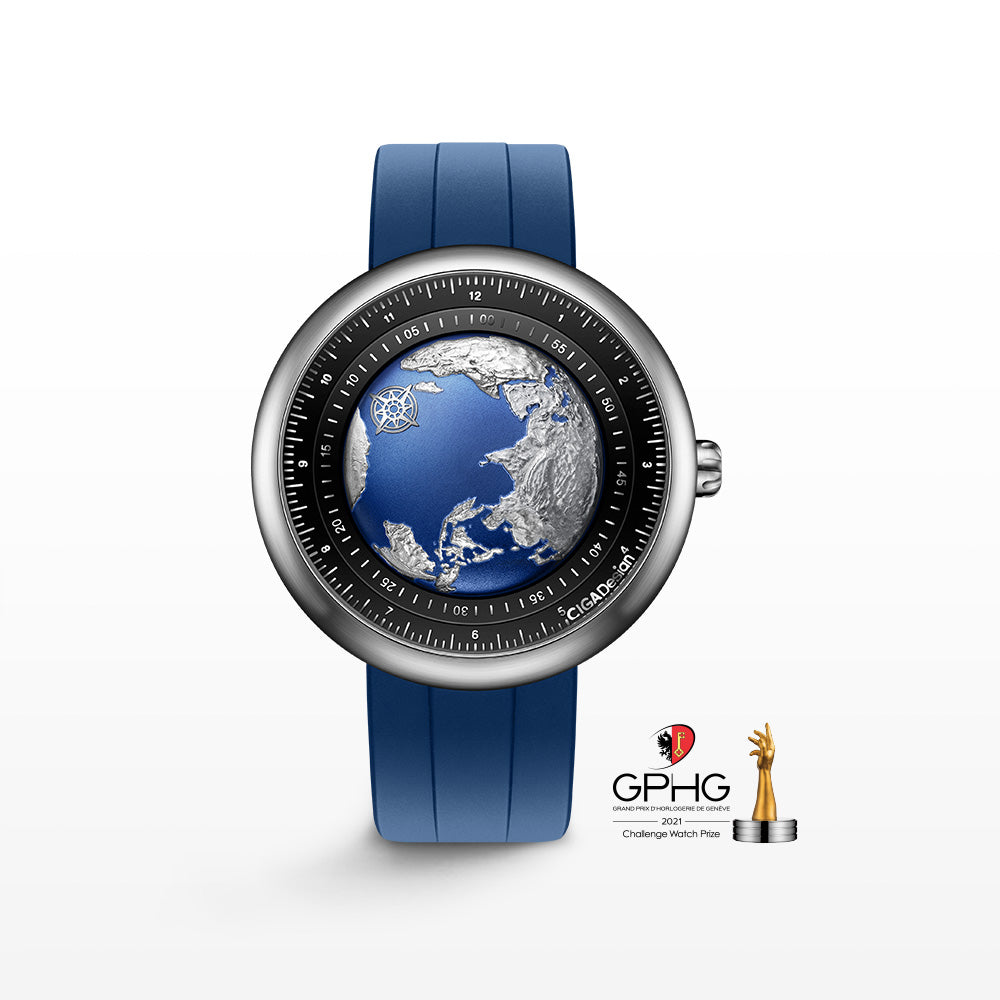
In 2021, the ClGA design Blue Planet stood out among
208 global watch entries competing for 14 prestigious awards. lt earned a spot on the stage of the Grand
Prix d'Horogerie de Genève (GPHG) - the “Oscars of Watchmaking”.

In 2021, the ClGA design Blue Planet
stood out among 208 global watch
entries competing for 14 prestigious awards.
lt earned a spot on the stage of the Grand
Prix d'Horogerie de Genève (GPHG)
the “Oscars of Watchmaking”.

Carbon
Case Color
Silver
Case Color
Case Size:
Case Thickness:
Case Material:
Crown:
45.0mm
11.8mm
316L stainless steel
6.5mm diameter,
CNC grooved
Strap Width:
Strap:
Tapered, 22.0mm x 20.0mm
Black fluororubber,
hidden clasp
Hands:
Integrated wandering
assembly,openworked,
Côtes de Genève
Lume:
Swiss Super-LumiNova,
Dark Green
Glass:
Water Resistance:
Sapphire crystal
5ATM
Movement:
Self-developed automatic wandering-hour Caliber CD-08 based on Miyota 9000
series, running at 28,800 vph, with a 42-hour power reserve, 24 jewels, and an
accuracy of -10 to +20 s/day.


Carbon
Case Color
Silver
Case Color
Case Size:
Case Thickness:
Case Material:
Crown:
45.0mm
11.8mm
316L stainless steel
6.5mm diameter,
CNC grooved
Strap Width:
Strap:
Tapered, 22.0mm x 20.0mm
Black fluororubber,
hidden clasp
Hands:
Integrated wandering
assembly,openworked,
Côtes de Genève
Lume:
Swiss Super-LumiNova,
Dark Green
Glass:
Water Resistance:
Sapphire crystal
5ATM
Movement:
Self-developed automatic wandering-hour
Caliber CD-08 based on Miyota 9000 series,
running at 28,800 vph, with a 42-hour power
reserve, 24 jewels, and an accuracy of -10 to
+20 s/day.

Want to linger with time as it wanders?
Join early access and claim your exclusive perk!

Want to linger with time as it wanders?
Join early access and claim your exclusive perk!
- Choosing a selection results in a full page refresh.